
Whether you're a startup in Austin, an enterprise in London, a fintech in Dubai, a retailer in Sydney, a manufacturer in Munich, or a growing team in Tokyo, Seoul, or Bengaluru, the question is the same: how much should AI development actually cost, and where does the money really go?
Most companies get their first estimate wrong, not by a small margin, but by two or three times the real figure. That happens because AI cost is rarely a single number. It's a layered investment across data, compute, model training, integration, compliance, and ongoing operations. Skip a layer in your planning, and the budget breaks somewhere down the line.
This guide lays out every cost variable that matters in 2026, built for teams evaluating AI development globally, and shows how CloudTrains Global structures pricing to keep it transparent from day one.
Key Takeaways
Custom AI development typically costs between $15,000 for a narrow proof of concept and $600,000+ for a full enterprise platform.
AI chatbot development generally falls between $20,000 and $150,000, depending on NLP depth and integration scope.
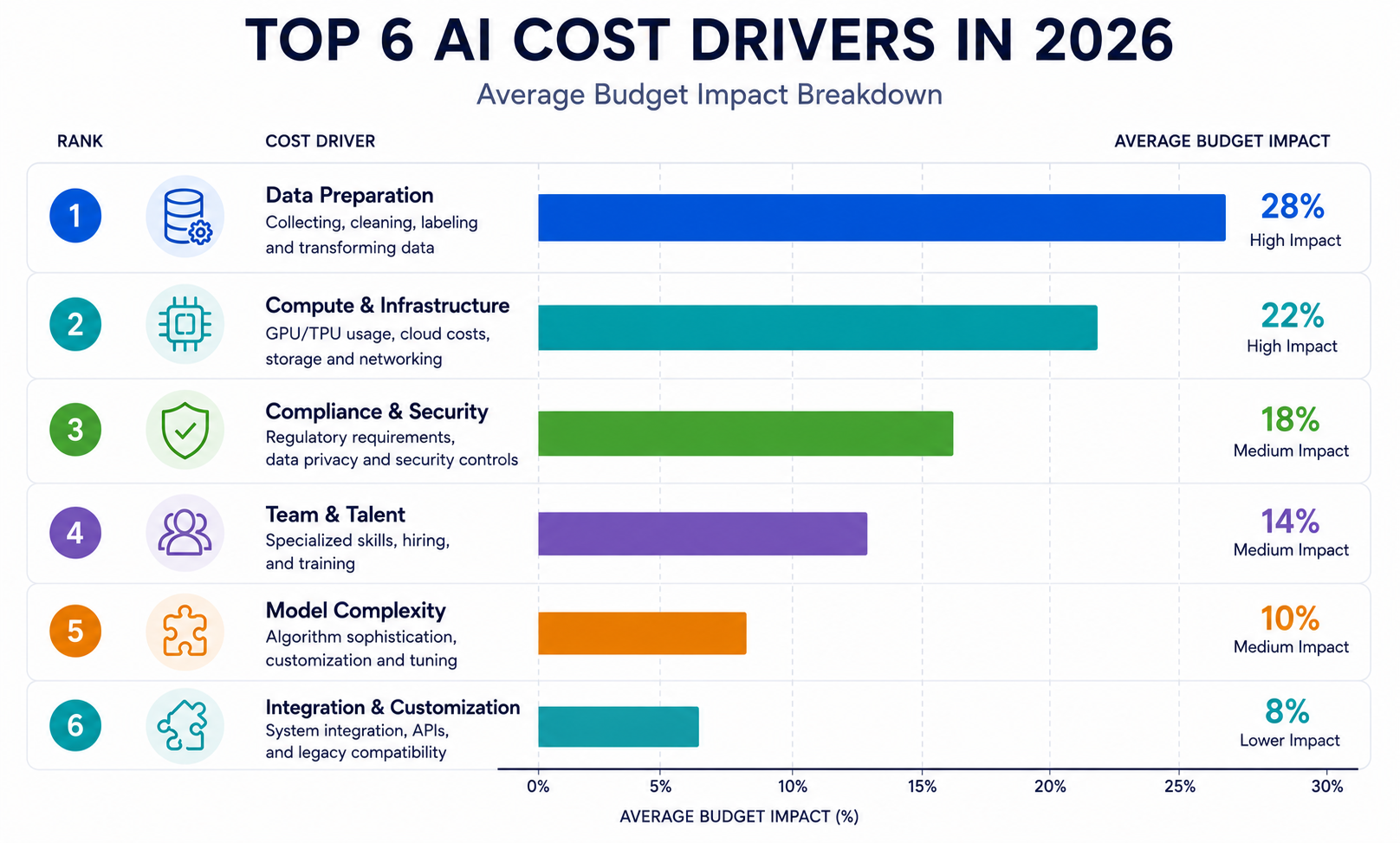
Data preparation alone can absorb 20 to 40 percent of a project's total budget.
Cloud compute for model training adds anywhere from $10,000 to $200,000+, depending on scale.
Compliance-heavy AI builds (HIPAA, GDPR, SOC 2, PDPA, or local data protection laws) add 20 to 40 percent on top of baseline scope.
Offshore development rates from India range from roughly $25 to $60 per hour, compared to $100 to $250+ per hour for US or Western European senior ML talent, often with comparable output quality when the team has the right experience.
Hidden post-launch costs, inference fees, retraining, monitoring, can quietly add $40,000 to $200,000+ per year on an enterprise-scale system.
What Does "AI Development Cost" Actually Mean?
AI development cost is the total investment needed to design, build, train, deploy, and keep an AI system running, not just the price of writing the code. It spans data work, compute, engineering time, infrastructure, testing, compliance, and continuous maintenance after launch.
Most online estimates only price the build phase. A realistic budget has to account for the full lifecycle, from the first data audit to the ongoing model retraining a year later. A narrow, single-purpose AI tool sits at one end of the cost spectrum. A multi-model enterprise platform with real-time inference and compliance monitoring sits at the far other end.
How Much Does AI Development Cost in 2026? The Range
In 2026, AI development typically costs between $15,000 for a basic proof of concept and $600,000 or more for a full enterprise-grade platform. Most mid-market custom builds land somewhere between $70,000 and $250,000.
Four variables decide where a project falls on that range: model complexity, data requirements, integration depth, and compliance obligations.
Proof of concept: $15,000 to $40,000. Narrow scope, limited data, built on a pre-trained model base.
MVP development: $35,000 to $100,000. Core functionality, one primary model, basic integrations.
Full custom AI system: $100,000 to $500,000+. Multi-model pipeline, proprietary data, production-grade infrastructure.
Enterprise AI platform: $250,000 to $1M+. Compliance layers, security hardening, multi-tenant architecture, white-labeling.
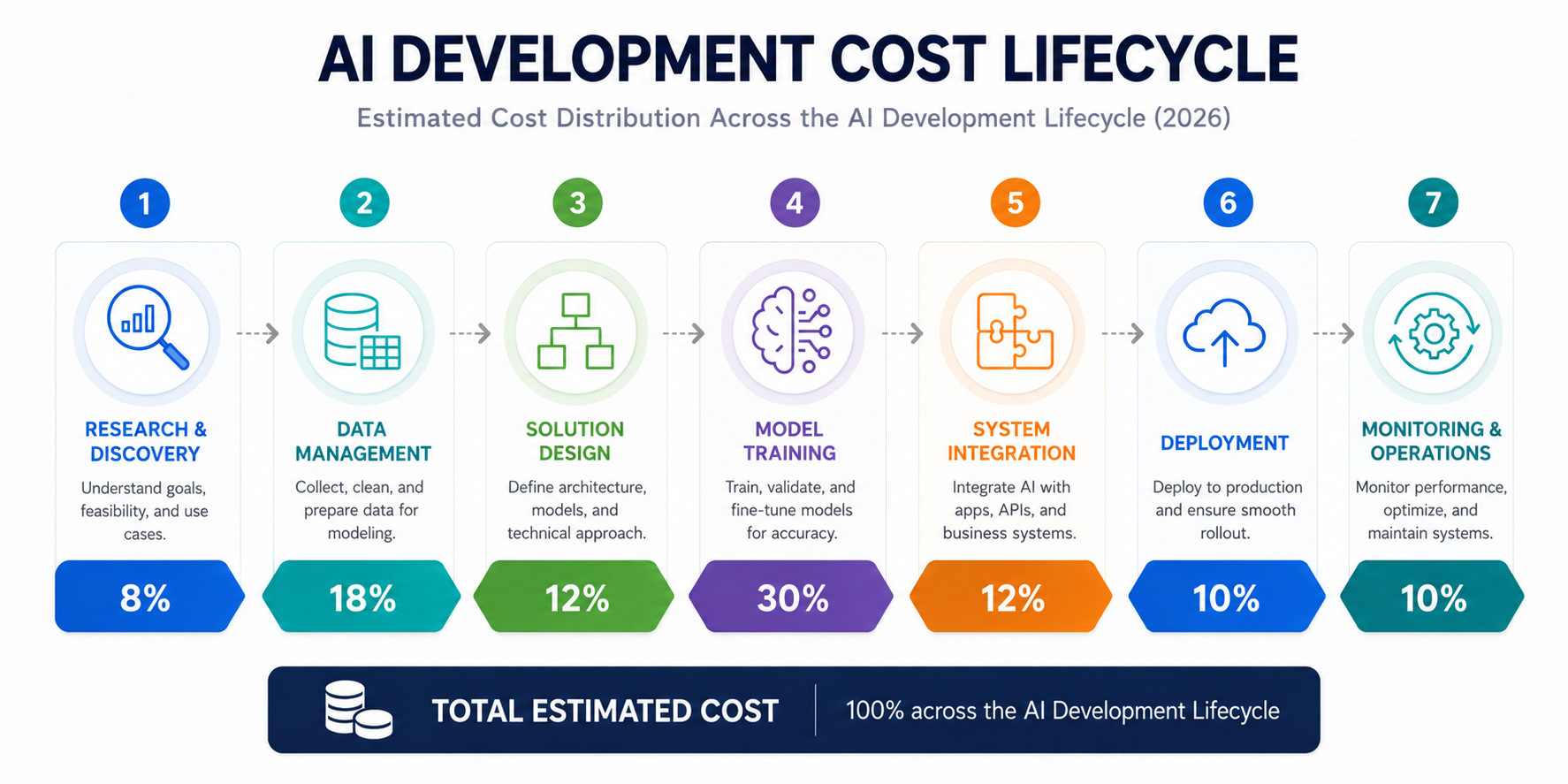
AI Development Cost Breakdown by Component
Component | Estimated Cost Range (USD) | What It Covers |
|---|---|---|
Discovery & Requirements Analysis | $4,000 – $18,000 | Scoping, data audit, feasibility study |
Data Collection & Preparation | $8,000 – $70,000 | Cleaning, labeling, structuring; scales with volume |
Model Architecture & Design | $12,000 – $55,000 | Custom architecture vs. pre-trained base model |
Model Training & Fine-Tuning | $15,000 – $180,000+ | Compute cost scales with dataset and model size |
API Development & Integration | $12,000 – $45,000 | CRM, ERP, and third-party system connections |
UI/UX & Application Layer | $8,000 – $35,000 | Interface design and front-end build |
Testing, QA & Security Audit | $8,000 – $30,000 | Functional testing, red-teaming, compliance checks |
Deployment & MLOps Infrastructure | $12,000 – $50,000 | Cloud setup, CI/CD pipelines, monitoring hooks |
Post-Launch Maintenance (Annual) | $18,000 – $70,000+ | Drift monitoring, retraining, support |
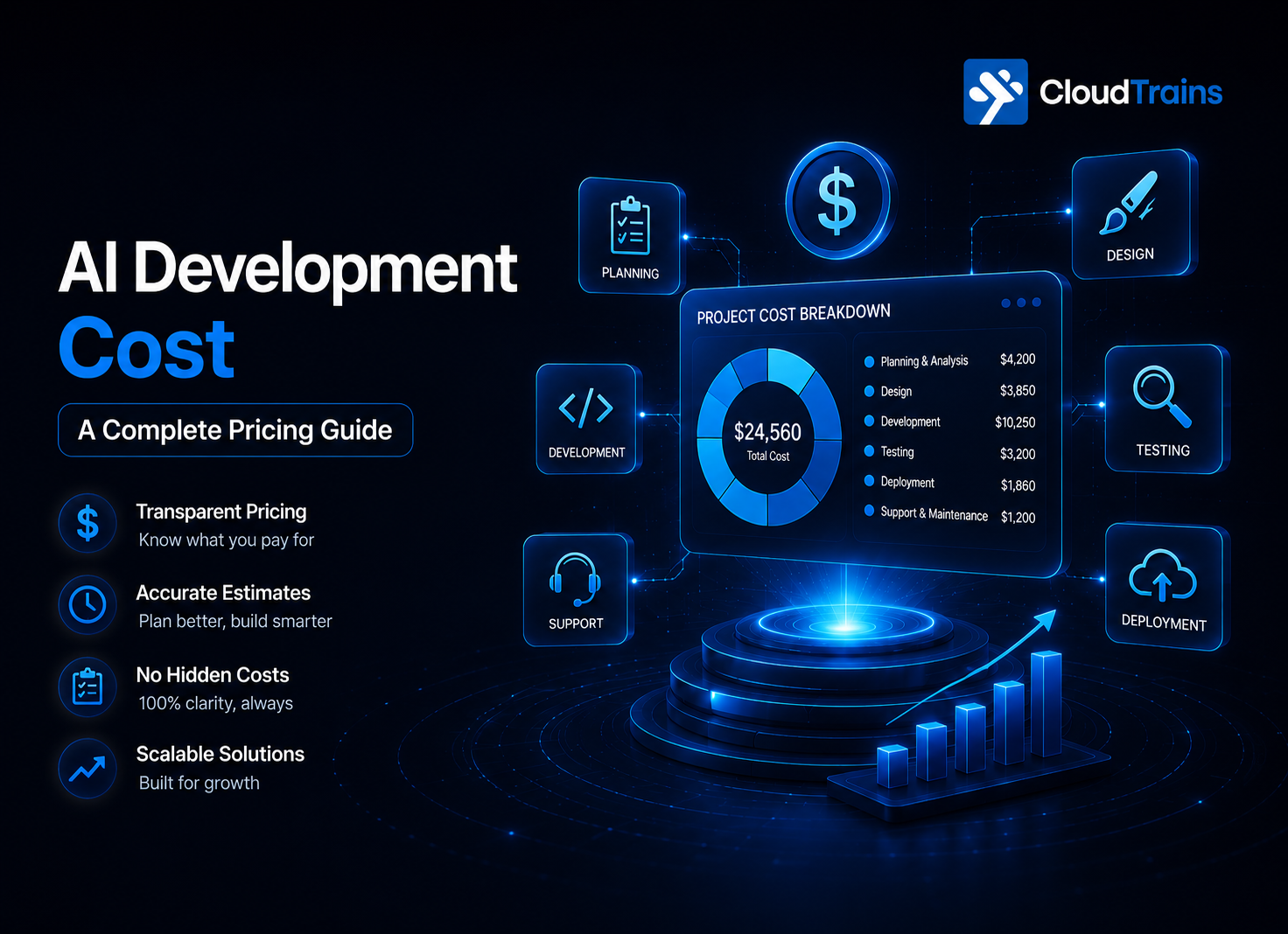
Total Range | $45,000 – $600,000+ | Varies by complexity and scale |
The Hidden Costs Most Vendors Never Mention
Most vendors quote the build. What happens after go-live is where budgets quietly break. These are standard operating costs for any production AI system, not edge cases, and they rarely show up in an initial quote.
Inference and API usage fees. Every request your AI system processes consumes compute. At low volumes it's negligible. A customer-facing tool handling 300,000+ monthly queries can generate $6,000 to $35,000 in monthly inference costs depending on model size and provider pricing.
Model retraining and drift management. Models degrade as user behavior and data patterns shift. A single retraining cycle for a mid-scale model typically runs $2,500 to $12,000. Systems that need monthly retraining can add $30,000 to $150,000 a year.
Vector database and embedding storage. Any system using RAG or semantic search needs a vector database. At enterprise data volumes, this typically runs $400 to $6,000 per month, a line item most early-stage budgets skip entirely.
Monitoring and observability. Production AI needs continuous tracking for performance drift, bias, and security anomalies. Expect $800 to $4,500 per month depending on system complexity.
Compliance and audit maintenance. Compliance isn't a one-time sign-off. Ongoing audit logging, annual security reviews, and documentation updates for HIPAA, SOC 2, GDPR, or regional frameworks like UAE's PDPL or Australia's Privacy Act typically cost $12,000 to $45,000 per year.
Change management and adoption. Consistently the most underfunded line item. Teams need training, workflows need redesigning, and without structured adoption support, even a well-built AI tool underdelivers. This typically adds 10 to 20 percent to total project cost.
Estimated total hidden cost for a mid-scale enterprise AI system: $50,000 to $220,000 per year, on top of the initial build.
Key Factors That Drive AI Development Cost
1. Data Quality and Preparation
Clean, labeled, domain-specific data is the foundation of any working AI system, and it's where budgets most often overrun. Raw enterprise data is rarely training-ready; it needs cleaning, normalization, annotation, and sometimes synthetic augmentation. Data work typically consumes 20 to 40 percent of total project cost.
2. Model Architecture Complexity
A narrow classification model costs far less to build than a generative AI system built on a large language model. LLM fine-tuning generally ranges from $8,000 to $130,000+, depending on the base model, dataset size, and number of training cycles. Pre-trained foundation models (from OpenAI, Anthropic, or Google) cut training cost but add their own licensing and API constraints.
3. Cloud Compute and GPU Infrastructure
Training and inference are compute-heavy, and GPU pricing has climbed sharply with global AI demand. A mid-scale custom model typically needs $8,000 to $70,000 in cloud compute for training; frontier-scale LLMs need far more.
4. Team Composition and Location
This is where the numbers vary most by region, and where an international client can save significantly without sacrificing quality.
Region | Typical Senior ML/AI Engineer Rate (USD/hr) |
|---|---|
United States | $130 – $250 |
United Kingdom / Western Europe | $100 – $200 |
Germany | $110 – $190 |
Australia | $110 – $210 |
UAE (local teams) | $90 – $180 |
Japan / South Korea | $100 – $200 |
India (experienced offshore teams) | $25 – $65 |
The gap doesn't have to mean a quality trade-off. Experienced India-based teams, like CloudTrains, working with international clients across the US, UK, and Middle East regularly deliver enterprise-grade architecture at a fraction of onshore cost, because engineering talent cost and engineering talent quality are two different variables.
5. Integration and System Complexity
AI rarely runs in isolation. Enterprise deployments connect with ERPs, CRMs, data lakes, internal APIs, and customer-facing apps. Each integration layer adds scoping, development, testing, and long-term maintenance. Legacy systems, common in established US and European enterprises, add further complexity.
6. Compliance and Regulatory Requirements
Requirements differ sharply by market:
US: HIPAA (healthcare), SOC 2, CCPA
UK/EU: GDPR, UK Data Protection Act
UAE: PDPL, DIFC Data Protection Law
Australia: Privacy Act, APPs
Germany: GDPR plus BSI security standards for critical infrastructure
Japan: APPI (Act on Protection of Personal Information)
South Korea: PIPA
India: DPDP Act 2023
Regulated builds typically need 20 to 40 percent above baseline budget for governance, audit logging, and explainability frameworks.
AI Development Cost vs. Traditional Software
Factor | Traditional Software | Custom AI Development |
|---|---|---|
Upfront cost | $25K – $140K | $45K – $600K+ |
Timeline to launch | 3 – 9 months | 4 – 12 months |
Scalability | Linear cost growth | Efficient at scale with cloud optimization |
Ongoing maintenance | Bug fixes, updates | Model retraining, drift monitoring |
Value delivery | Fixed feature set | Improves with more data over time |
Compliance overhead | Standard QA | AI-specific governance and auditing |
ROI horizon | 6 – 18 months | 12 – 36 months, compounding |
Expertise required | General dev teams | ML engineers, data scientists, architects |
AI carries higher upfront complexity, but it compounds in value in a way static software typically doesn't.
AI Development Cost by Project Type
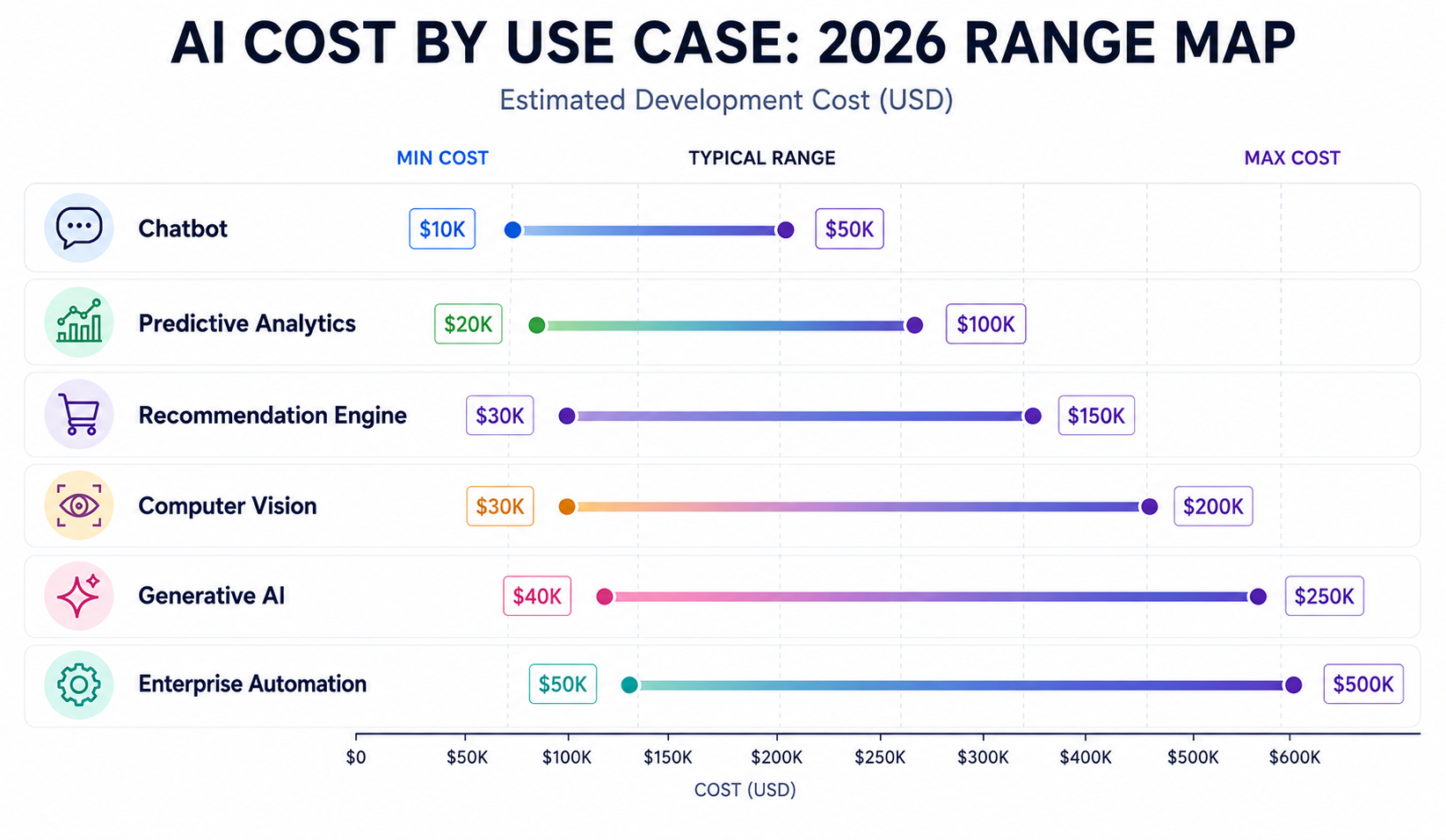
AI Chatbot Development: $20,000 to $150,000. A basic FAQ bot built on a pre-existing NLP framework can come in under $28,000. A context-aware, CRM-integrated enterprise assistant with proprietary knowledge-base fine-tuning starts around $70,000.
Predictive Analytics: $35,000 to $180,000. Covers data pipeline construction, feature engineering, model selection, validation, and dashboard integration. Common across retail demand forecasting and SaaS churn prediction.
Recommendation Systems: $55,000 to $220,000. Real-time personalization at scale needs meaningful infrastructure investment: collaborative filtering, embedding models, and continuous retraining. Rule-based, simpler versions cost far less.
Computer Vision: $70,000 to $380,000, depending on accuracy requirements and edge deployment needs. Labeling visual training data is time-intensive; projects needing 100,000+ annotated images should budget $25,000+ for data preparation alone.
Generative AI and LLM Applications: Starts around $90,000 for custom enterprise builds. Fine-tuning a foundation model on proprietary data adds $18,000 to $140,000 depending on token volume and training cycles. Retrieval-Augmented Generation (RAG) has become the more cost-efficient route for knowledge-heavy use cases.
AI-as-a-Service vs. Custom Build: Which Costs Less, and When
This is the decision most teams face before development even starts. The right answer depends on usage volume, data sensitivity, and how much control you need over the model.
AI-as-a-Service (AIaaS) means building on top of existing foundation models through APIs, OpenAI, Anthropic, Google, Cohere. Upfront cost is low; integration typically runs $12,000 to $55,000, with no training cost and no GPU infrastructure to manage.
Where it gets expensive: API pricing is usage-based. A system processing two million tokens a day on frontier-class models can generate $15,000 to $50,000 in monthly API fees. At that volume, a custom fine-tuned model usually pays back its build cost within 9 to 14 months.
Approach | Upfront Cost | Monthly Cost at Scale | Control | Data Privacy |
|---|---|---|---|---|
AIaaS (API-based) | $12K – $55K | $4K – $50K+ | Low | Shared infrastructure |
Fine-tuned foundation model | $35K – $140K | $2K – $9K | Medium | Configurable |
Fully custom model | $130K – $550K+ | $3K – $14K | Full | On-premise or private cloud |
Choose AIaaS when you're validating a use case, operating at low to medium volume, or need to move fast: a working AIaaS product in 60 days beats a custom model in nine months for most early-stage decisions.
Choose custom when monthly API costs approach $10,000, when your data legally or contractually cannot leave your infrastructure (common for healthcare, banking, and government work in the US, EU, and UAE), or when the system needs to reason over proprietary knowledge no general-purpose model has.
The hybrid path most enterprises take in 2026 uses a foundation model as the reasoning layer, then adds proprietary data through a RAG architecture on top. This cuts fine-tuning cost by 40 to 70 percent while keeping domain accuracy high, and it's the most cost-efficient setup for knowledge-intensive applications at mid-scale.
How CloudTrains Global Structures AI Development Pricing
CloudTrains Global works with clients across the US, UK, UAE, Australia, Germany, and other parts of Europe, alongside Japan, South Korea, and India, building AI-powered chatbots, business automation systems, and custom software. A few things shape how we price and deliver:
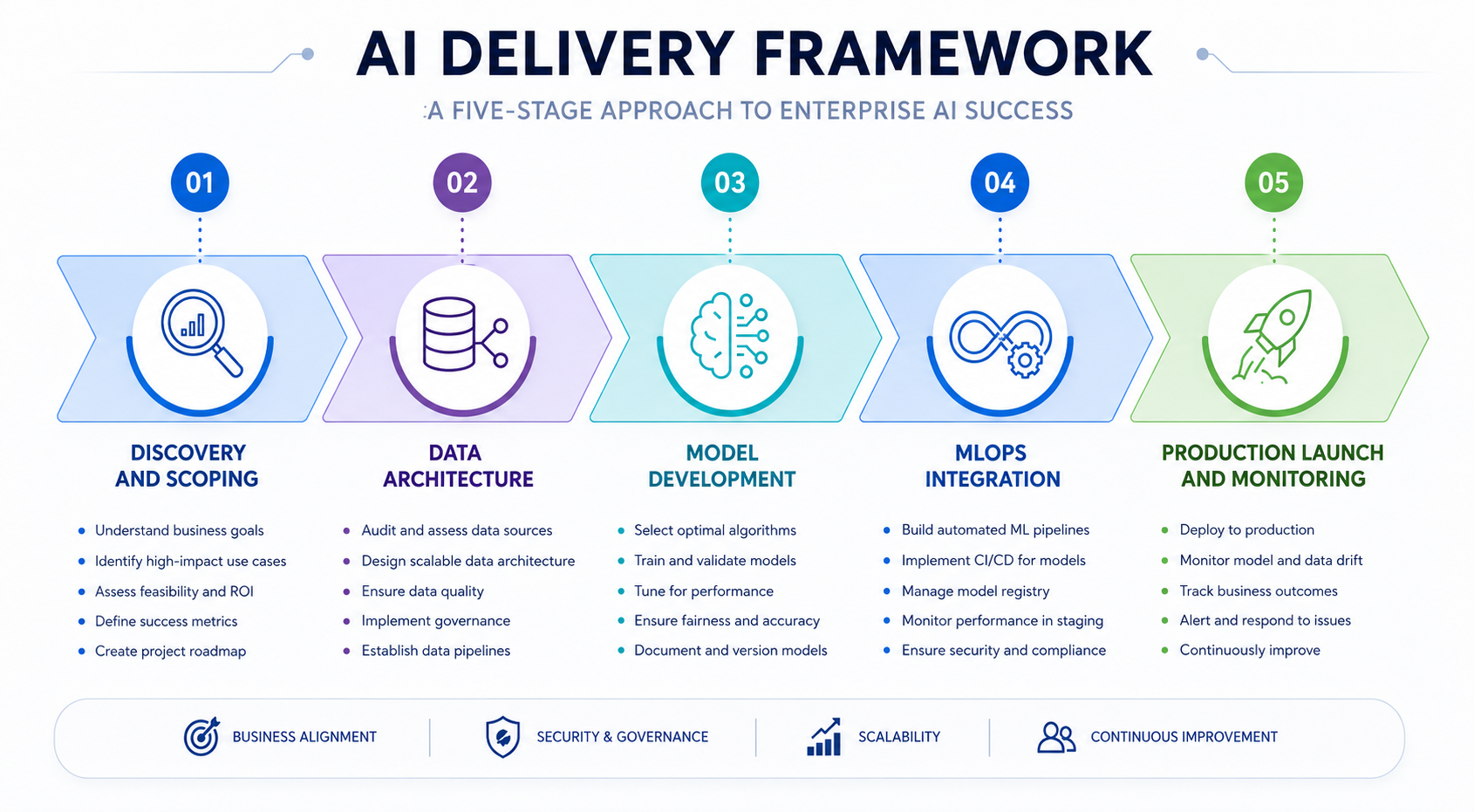
Discovery before code. Every engagement starts with a data and use-case audit, not a generic template pitch.
Phased, transparent pricing. You know the cost of each phase before it starts. No mid-project surprises, no vague "final invoice."
Location-based cost efficiency. With delivery teams in Noida and Gwalior alongside a Florida (USA) office, CloudTrains offers international clients senior-level AI engineering at meaningfully lower rates than US, UK, or Western European agencies, without diluting quality or communication.
Compliance-aware architecture. Whether a client needs GDPR alignment for an EU rollout, HIPAA for a US healthcare product, or PDPL considerations for a UAE deployment, compliance is built into the architecture from the start, not bolted on afterward.
Full-stack delivery. Data engineering, model development, API integration, and UI/UX under one team, so nothing gets lost in handoffs between vendors.
How to Reduce AI Development Cost Without Cutting Quality
Start with a narrow proof of concept before committing to a full platform build.
Use pre-trained foundation models wherever the use case allows, instead of training from scratch.
Choose RAG architecture over full fine-tuning where possible: it typically cuts cost by 40 to 70 percent with comparable accuracy.
Phase compliance work by actual risk level rather than front-loading every requirement at once.
Right-size cloud infrastructure. Many teams over-provision GPU instances for inference; spot instances, quantization, and async processing can cut cloud spend by 30 to 60 percent.
Work with an offshore-capable partner for the engineering-heavy phases, while keeping strategy and compliance oversight local if your industry requires it.
Frequently Asked Questions
Q1: How much does it cost to build an AI app in 2026? Between roughly $35,000 for an MVP and $600,000+ for a full enterprise platform, depending on model complexity, data needs, compliance requirements, and integration scope.
Q2: What's included in a full AI development cost breakdown? Discovery and scoping, data collection and preparation, model architecture, training and fine-tuning, API integration, UI/UX, testing and security, deployment, and ongoing maintenance. Each phase has its own cost drivers.
Q3: How much does AI chatbot development cost? From roughly $20,000 for a basic FAQ bot to $150,000+ for an enterprise-grade conversational AI with CRM integration, multi-language support, and proprietary fine-tuning.
Q4: What does LLM fine-tuning cost in 2026? Generally $8,000 to $130,000+, depending on the base model, dataset size, and compute hours required. RAG offers a cheaper alternative, often 40 to 70 percent lower, for knowledge-retrieval use cases.
Q5: How does AI development cost compare to traditional software? AI typically costs 2x to 4x more upfront for a comparable feature set, but it improves with data over time and can deliver compounding ROI where traditional software plateaus after launch.
Q6: What drives up the cost of custom AI development the most? Poor data quality requiring heavy preprocessing, high model complexity, real-time inference infrastructure, compliance requirements, and deep legacy-system integrations. Each can independently add 20 to 50 percent to project cost.
Q7: How do offshore AI development rates compare across regions? US senior ML engineers typically bill $130 to $250/hr, UK and Western Europe $100 to $200/hr, Australia $110 to $210/hr, UAE-based teams $90 to $180/hr, and experienced India-based teams like CloudTrains $25 to $65/hr, often with comparable delivery quality for well-scoped projects.
Q8: How much should an enterprise budget for AI in 2026? High-performing organizations tend to allocate a meaningful share of their overall digital budget to AI. For most mid-market companies, a realistic starting range for a first major AI system is $100,000 to $450,000, plus ongoing operating cost.
Q9: Is it safe for US, UK, or EU companies to outsource AI development to India? Yes, when the partner has the right compliance awareness. CloudTrains structures data handling, access controls, and contractual terms to align with the client's home-market regulations (GDPR, HIPAA, PDPL, etc.), not just Indian data norms.
Final Thought: Budget for the Full AI Lifecycle, Not Just the Build
AI development cost in 2026 isn't a fixed number. It's a function of scope, data, architecture choices, compliance obligations, and the quality of the team building it. The organizations getting the strongest return aren't the ones spending the most; they're the ones who scoped correctly, built for scale from day one, and treated AI as an ongoing capability rather than a one-time project.
Whether you're based in New York, London, Dubai, Sydney, Berlin, Tokyo, Seoul, or anywhere in between, CloudTrains Global can help you scope an AI system that fits your actual budget, not an inflated estimate or an underpriced one that stalls halfway.